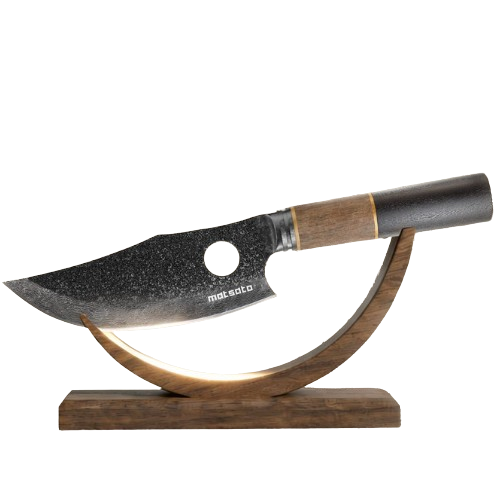
Santoku-style chef knife
4CR14 stainless steel, cryogenically ice-hardened, full-tang construction — here's exactly where this sits against traditional Japanese Santoku knives, and the honest trade-off.
Matsato uses a similar blade profile at a much lower price point. That's not a red flag — it's a real trade-off worth understanding: the difference typically comes down to steel grade and hand-finishing compared to higher-end artisan blades, not a fake knife pretending to be something it isn't.
A mid-range stainless steel, cryogenically ice-hardened as part of manufacturing — a treatment step most knives in this price range skip.
The blade extends through the full length of the handle, a genuine durability feature typically found on higher-quality knives.
Secured with stainless steel rivets, shaped to fit the palm for extended prep work.
Gently curved with a flat edge and tapered tip — suited to general prep work like slicing, dicing, and trimming.
The honest comparison: traditional Japanese Santoku knives commonly run $100-200+. The trade-off here is typically steel grade and hand-finishing, not the core blade geometry.
Real specs, honest trade-off — see current pricing.
Cryogenic ice-hardening is a genuine metallurgical treatment that can improve edge retention and durability in steel — it's a real process, not an invented buzzword. The fact that it's included at this price point is a real point in the knife's favor.
4CR14 is a mid-tier stainless steel, common in budget-to-mid-range knives. It won't match the edge retention of premium steels used in higher-end Japanese blades, but it's a reasonable, functional choice for everyday kitchen use.
A $100-200 traditional Japanese Santoku typically reflects premium steel grades (sometimes multi-layered Damascus construction), extensive hand-finishing, and often smaller-batch craftsmanship. Matsato's lower price reflects a more standardized manufacturing process and mid-tier steel. Neither is dishonest — they're different products at different price points, and it's fair to know which one you're buying before you order.
No pressure, no fine print you have to hunt for. The answers below are the ones that actually matter before you order.
4CR14 stainless steel, cryogenically ice-hardened as part of the manufacturing process — a treatment step most knives in this price range skip.
Beechwood, secured to the full-tang blade with stainless steel rivets. It's shaped to fit the palm and stay comfortable through extended prep work.
Hand wash and dry immediately to prevent rust, and use a whetstone or honing steel for sharpening. Avoid dishwashers, which can dull the edge and stress the handle over time.
Traditional Japanese Santoku knives commonly sell for $100-200 or more. Matsato uses a similar blade profile at a lower price point — the trade-off is typically in the steel grade and hand-finishing compared to higher-end artisan blades.
Before you order: This is a mid-tier knife at a mid-tier price, not a $150 artisan blade at a discount. The steel grade and finishing reflect the price point honestly.
Santoku-style blade, cryogenic hardening, full-tang construction.