Screenless health tracker
One-time purchase, unlike WHOOP's required membership. Here's what independent testers actually measured on battery life, blood pressure, and heart rate accuracy.
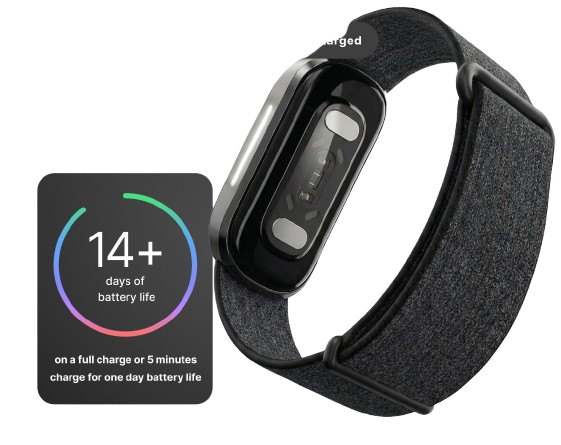
Hume states up to 7 days of battery life, and the 2.0 update reportedly pushes some users closer to 14 days. But one reviewer running full 24/7 continuous tracking for 8+ weeks measured closer to 4-5 days in real use. Actual results depend heavily on which tracking features you leave on.
A real, genuine differentiator from WHOOP, which needs an active membership just to function. Hume's core metrics are free; the $8.99/month Hume Plus tier is optional.
One side-by-side test found the systolic reading close to an arm cuff (122 vs 123) — though the diastolic reading ran lower than the cuff in that same comparison.
Built for continuous sleep and recovery tracking rather than daily notification checking — a real design tradeoff, not a missing feature.
Flags biometric pattern changes over time using HRV, SpO2, sleep, blood pressure trends, and skin temperature — the brand is explicit this is a wellness tool, not a diagnostic one.
A known weakness of wrist-based sensors: during a strength session, one reviewer's Hume topped out near 131bpm while a chest-strap-based WHOOP read into the 150s on the same lift.
Real differentiators, real limits checked against independent testing — see current pricing.
WHOOP requires an active annual membership (roughly $200-$359/year) for the tracker to function at all — without it, the hardware is essentially inert. Hume Band 2.0 takes the opposite approach: core sleep, recovery, and heart rate metrics work in the free app indefinitely, with an optional $8.99/month tier for deeper trend reports and guided workouts.
Multiple independent reviewers who tested both devices side by side reported the premium tier felt like an extra, not a necessity — which is a meaningfully different value proposition from a device that stops working without payment.
The blood pressure feature uses optical wrist sensors rather than a cuff, and one comparison found the systolic reading reasonably close to a cuff reading while the diastolic ran lower. Under heavy strength training load, wrist-based heart rate sensors generally underperform compared to chest straps — one reviewer's side-by-side test showed a real gap during a lifting session specifically.
None of this means the device doesn't work — it means it's built for longevity and sleep tracking rather than precise athletic performance metrics, and the brand itself frames the illness-pattern feature as wellness monitoring, not clinical diagnosis.
No pressure, no fine print you have to hunt for. The answers below are the ones that actually matter before you order.
No. Hume Band 2.0 is a one-time purchase, and all core wellness and fitness metrics are available in the free app. An optional $8.99/month Hume Plus tier adds a Health Score, deeper trend reports, and guided workouts, but multiple independent reviewers say it isn't necessary for the base experience — unlike WHOOP, which requires an active membership for the tracker to function at all.
The brand states up to 7 days, with some reviewers reporting closer to 14 days with the 2.0 update. However, at least one independent reviewer running 24/7 continuous tracking measured closer to 4-5 days in practice. Actual battery life depends heavily on which tracking features are enabled.
One independent side-by-side test found Hume Band 2.0's systolic reading close to an arm cuff (122 vs 123), but noted the diastolic reading ran lower than the cuff in comparison. The brand states this is a wellness trend feature, not a diagnostic-grade reading.
Like most wrist-based trackers, it has known limits under heavy load. One reviewer's side-by-side comparison during a strength session showed Hume Band topping out near 131bpm while a chest-strap-based device read into the 150s on the same lift — a documented weakness of wrist sensors generally, not unique to this device.
Worth knowing: The "$356 retail" reference price used to frame the current price as a discount isn't independently verifiable — treat it the way you would any brand-stated "was" price. The Chronic Illness Indicator is explicitly a wellness pattern-flagging tool, not a diagnostic feature.
Screenless health tracker with blood pressure trends and no required membership.